As all the children's literature people in America know, tomorrow is the announcement of the American Library Association's Youth Media Awards. It's a magical time for those of us who love children's books. I haven't attended in person for many years, but I usually watch the livestream of the announcements. You can still cheer along with the crowd as the titles are called and authors' lives are changed forever. I've read many accounts of the phone calls authors get early that Monday morning from the committees, telling them they've won, and the stories always bring tears to my eyes.
Of course, it would be very difficult for me to choose the book that I think will win these awards, so instead I wanted to honor a clever salute to a Caldecott Honor winner. The Caldecott Honor winner is Madeline, and the book I'd like to bring to your attention is Frankenstein: A Monstrous Parody (written by Ludworst Bemonster). I wish I could remember where I first saw this mentioned this fall, but it made me want to get it. Luckily our public library had it, and I am a little ashamed to admit that we have had it checked out ever since. The girls love it, and keep asking to read it again. It is funny, clever and is a sweet love letter to a classic story.


The comparison is evident from the front covers. On the cover of Madeline, Miss Clavel walks towards the Eiffel Tower, trailing behind most of her twelve little charges clutching Madeline's hand. On the cover of Frankenstein, there is a creepy castle instead of the Eiffel Tower and Frankenstein peeking back at the reader. There is a clever seal on the cover as well which cites Frankenstein as a "Caldecott Horror book". And the font for the title and author is the same as well. All of it subtly sets up the reader for the experience they are about to have - familiar and yet a little creepy at the same time.
This is subtitled A Monstrous Parody, and it is indeed a perfect parody as it takes the well-known story of Madeline and turns it askew. In this story, the doctor is called by Miss Devel because it is too quiet down in the dungeon. There are twelve different monsters there, including all of the classic horror movie monsters. Besides Frankenstein, there is a skeleton, a werewolf, a mummy, the creature from the black lagoon, and others. But it is Frankenstein who attracts Miss Devel's attention. His head is missing! Frankenstein is trucked off to the laboratory, where he is given a new head, fastened on with those requisite screws. He wreaks havoc, eating the medical staff and the ceiling before Miss Devel and the rest of the group come to visit. And predictably, the night after the visit to the hospital, Miss Devel senses again that something is not right. She rushes to the dungeon door, only to see that every monster has lost their head. It is only in Miss Devel's hilarious response to this situation that the book deviates slightly, but it is great fun.
I think I should pause here to acknowledge that Ludworst Bemonster is a pseudonym for author Rick Walton and illustrator Nathan Hale. Their work is almost flawless and there is just as much enjoyment to be had for adult readers as there is for children who are familiar with Madeline. The rhyming text is almost perfect, and I am impressed with how well they created a story that had to both fit a pre-existing rhyme scheme and pay homage to the familiar plot. And the illustrations! The illustrations, too, pay homage to the original while also acknowledging the classic horror movies of our society. And just like the text, they have a sense of tongue in cheek humor too.
Hale has turned all those classic movie monsters into young children, and as frightening as they might want to be, they are pretty darn cute. On the front cover, Frankenstein turns to peek back at the reader, he does so with an adorable crooked grin that makes me want to scoop him up and kiss him. Miss Devel looks like a hip, steampunk mad scientist as she races down the stairs to her charges. And Dr. Bone wears a dapper suit and enormous voodoo mask with a large bone through its nose. These are the details that make this book so (dare I say it?) charming.
Where Madeline visits the zoo, and shows her bravery by pooh-poohing the tiger, Frankenstein actually frightens the other animals. The illustration shows Miss Devel frantically restraining some of the charges, while the rest run amok. The creature from the black lagoon is diving into the hippopotamus pool, the vampire is astride the ostrich, biting his neck. But the majority of the animals are watching Frankenstein, who stands calmly in the middle of the chaos. When they visit Frankenstein in the laboratory, the monsters arrive in a hilarious motorcycle/open-air carriage combination that really has to be seen. The looks of the drivers around them as Miss Devel steers determinedly are priceless.
This book is worth finding and comparing to Madeline. But it is clever and hilarious in its own right too. Enjoy the Youth Media Awards tomorrow, and find Frankenstein.
Frankenstein: A Monstrous Parody. Ludworst Bemonster. Feiwel and Fiends, 2012. borrowed from Lewis & Clark Public Library
Madeline. Ludwig Bemelmans. Scholastic, 1939, 1982.
personal collection
When TOON Books originally asked me to advertise their Maya Makes a Mess contest in July, I asked for a copy of the book to review along with the contest. I mentioned in the blog post how much I liked TOON Books, so I selfishly wanted the book for myself. When we got the book in the mail, the girls wanted to read it right away. Gloria ended up loving this book and reading it over and over. In fact, I've had a hard time holding onto it for long enough to get a review written! It's been a huge hit at our house.

The book opens with Maya and her parents eating dinner at the table. Her parents are scolding her for eating with her hands (something I am very familiar with!). The scolding continues: "'Sit down!' 'Sit up!'... 'Use a spoon!'. (p.6) Frustrated, Maya asks why she has to follow all these rules. Her father tells her "You need manners! What if you were eating dinner with the QUEEN?!" (p. 7). And then the doorbell promptly rings. Of course, it is the Queen's courtier. Maya is whisked off to court for a dinner party. She does point out htat she has already eaten, but that doesn't matter. When the royal dinner is served, it is made up of all the things a child does NOT like to eat - goose livers, snail salad, spinach juice and broccoli broth. So Maya pulls out her manners to request pasta with ketchup. She pats herself on the back for good manners, and when she isn't sure which fork is the pasta fork, she digs in to the pasta the way she always has. There are slurps, long noodles jammed into Maya's mouth, slipping through her teeth. Suddenly, Maya becomes aware that while she's enjoying herself, everyone in the room is staring at her.
Maya's total lack of manners is at first horrifying to the party guests. The Queen is shocked and disgusted. But when she asks Maya why she eats that way, Maya tells the Queeen that it makes food taste better. This then intrigues the Queen, who decides she (and everyone else at court) should try eating Maya's way. There is a huge free-for-all, with people eating messily, but enjoying every moment of it. And lest you parents worry that your children will want to eat like Maya all the time, the Queen declares that this has been so much fun that they will all eat like this again. But only on holidays.
In my first blog post on this book, I mentioned that I was a little leery of it. I, along with most parents, work hard to instill good manners and behavior in my daughters. I was afraid that this book would indulge bad manners, messy eating and ignoring the polite way to do things. I was especially afraid when Gloria kept reading it - poring over it again and again in her bed, on the couch, wherever she could find it. I was sure there was going to be a manners revolution in my house.
But I was so focused on the bad manners that I didn't realize Modan's subtle way of putting those manners into perspective. Maya's bad manners aren't applauded by the Queen at first. As I said previously, the Queen stops the entire dinner party in disgust. But it's the way Maya describes her way of eating that appeals to the Queen. When the Queen asks, repulsed, "...why, for heaven's sake, do you eat that way?" Maya tells her "It makes food taste better." and adds "much better!" (p. 25). It's Maya's total enjoyment that makes the Queen curious. The double page spread that follows is hilarious and gross at the same time. People are cramming lettuce in their mouths with their hands, slurping soup out of a ladle, feeding each other and spilling. But here is the best part - the Queen's dinner party has gone from being a stuffy affair, with too many forks and food no one wants to eat, to a fun party where the guests are relaxed, smiling, and enjoying themselves. That's what Modan is really emphasizing here. There is a time and a place for manners and fun. Maya may have mixed the two up slightly, but she has brought fresh air into the palace. And the Queen is wise enough to mandatethat this sort of fun should only take place on holidays. This isn't an everyday free-for-all - it's reserved only for special occasions.
For me, one of the best things about this book are the illustrative details. Modan gets the life of a young girl just right. From the very first panel, Maya is a total charming mess. As she leaves on the plane to the palace, she stands on the cabin stairway, waving cheerfully. She wears mismatched socks, scrunched around her feet, with no shoes and unkempt hair. Her parents fruitlessly wave a dress and a toothbrush at Maya while the ambassador mutters "'No time, no time!'" (p. 11). The Queen is much younger than Queen Elizabeth, but does have corgis that follow her every move. And the illustration of her at the wild feast, pouring ketchup into her mouth straight from the bottle, is simply perfect. There is nothing better. Oh, except for the long, loopy strand of spaghetti that meanders along the bottom of all the pages. It begins on the back of the title page, with a pot filled with boiled noodles. And it ends, on the last page, in a final perfectly fitting detail. Just perfect.
You may also remember from my blog post that I love how TOON Books has created these titles for easy readers. This book lists its reading level as Grades 1-2, and I would say for the most part that is exactly right. Many words are repeated throughout so if a child doesn't know it the first time they encounter it, they'll have plenty of opportunities to review it. The only place I thought an emerging reader might have trouble was with the food labels at the dinner party. I don't know many first graders who would recognize the words broth, livers or souffle, but that could just be nitpicking on my part. Otherwise this book is easy for a child to pick up and get great enjoyment from.
The visual literacy aspect is also strong. There are at the most six panels per page. Modan is careful to indicate movement from panel to panel, so the new reader can easily decode which panel they should look at next. And text and illustrations work together harmoniously. Maya is very expressive, and Modan includes lots of emphasis in the text through bold fonts and italics. It's easy to see how the text should be read. All in all, Maya is a fun book to share with young readers. It might make them not just a voracious reader, but a polite eater too.
Maya Makes a Mess. Rutu Modan. TOON Books, 2012.
sent by publisher for review
I've written here before about our visits to the local public library. While I check out picture books and nonfiction that appeal to me, Frances and Gloria also check out books, puppets, book & CD kits, and DVD's that they select themselves. Frequently, Gloria selects the same board books over and over again, even at four years old. And sometimes their selection is one we read dutifully and ship right back to the library. But every once in a while, one of their selections really surprises me. For instance, Gloria's choice of It's a Little Book was a happy find. I also wrote about her choice of Ooh La La Polka Dot Boots here. When Gloria chose Our Library a few weeks ago, I thought it would be a sweet read, considering how much we love the library. I had no idea how impactful this book would be for me personally.

This book begins with Miss Goose, the librarian, telling a group of young animals that the library is going to close. The animals can't believe it, and when they ask why, Miss Goose tells them that the building is too old and need a new roof. The group of animal children thinks hard, checks out books on making a new roof, roll up their sleeves, and get to work. But then Miss Goose tells them that the library needs money. And the group does the same thing - check out a book. Then "we read by day, and we read by night." (p. 9). They find a way to earn money. Then the library must be moved to a new location. But instead of throwing up their hands (paws?) and giving up, the animals check out a book and figure out how to get the job done. Their final hurdle is a substantial one, but these library lovers can tackle that, too. And when they are finished, the library is a richer place - not only for their efforts, but for their love and belief in the library.
Eve Bunting shows library advocacy at its most primal in this story. Not only does this book show young readers a group of their peers working for something they believe in, but she also shows them working together for a common goal. These library lovers want their library to survive, and as young as they are, they are willing to learn any skill to save it. I also love that a huge part of their advocacy plan includes learning these skills at the library itself. They quite literally would not be able to achieve this goal without the library. In a way, the library saves itself through its information.
It goes without saying that I am a library lover. Ever since I was old enough to sign my name on the paper card, I have been a prolific library user. I have always seen libraries as a place of refuge, information, and kindred spirits. I grew up using a small county library in San Diego, where the librarians all knew me, and saved the children's discards for my own personal collection (I still have a few!). Once I became a librarian, I moved from community to community precisely to provide services to children and teens. It has always been a job I loved, a job where I felt I could make a difference, a job where I could change lives. My final children's librarian job was in Glendale, Arizona, as the Youth and Teen Services Coordinator at the Glendale Public Library. I worked there for five years. At that time, it was an amazing system, with a huge emphasis on welcoming the patrons who will impact services in an ongoing way - young people. Glendale was a place I was proud to work for, with incredibly talented, enthusiastic librarians in every department in every branch.
You may have heard stories of what has been happening in the Glendale libraries, but it is nauseating and dizzying. Even before I left Glendale, as the economy spiraled downward, services were being cut left and right. I should say that this blog post is, of course, my own interpretation of these events, but it has also been reported by the media. Look at articles from this past year here, here, here, and here. Cuts continued to happen as the City Council took money from every possible part of the budget to support the sports complex that had built right before the recession hit. Then the real shock - it was announced that the libraries might lose hours, materials, programming, librarians and possibly even close buildings to help make up an enormous budget shortfall. This happened to other departments within the city of Glendale as well, but what was most important to me were the libraries.
But something happened in Glendale. There had always been a very vibrant teen volunteer group in our libraries. In fact, as services, hours and staff had been cut, our teen volunteers had done more and more work to help continue to provide quality services to patrons. And when the news hit that their library would be dreadfully impacted, these teenagers (none older than 18 when this began) stood up and said they would not let this happen. They formed a group - called Save the Glendale Public Libraries and they bounded into action. These teens were patrons I knew very well - they used the library on an almost daily basis. Some of them even want to become librarians themselves. They intuitively knew library advocacy, and started attending the City Council meetings, speaking eloquently in protest of the cuts. They handed out flyers in front of the libraries and informed Glendale citizens of the service cuts and how this would impact their lives. Of course, these cuts didn't just affect children's and teen services. They affected job seekers, information retrieval, patrons who rely on the library for medical research, the latest news or even air conditioning when there is no respite. These teenagers spoke up. I have quite possibly never been as proud as I was of these teens.
And they turned the tide of the discussion. Voters came out and voted against the proposed cuts. But sadly, just because these teenagers won the battle doesn't mean they won the war. The libraries continue to operate on very tight budgets, and the librarians feel so uncertain that they are leaving and not being replaced. All of their skills, enthusiasm and ideas cannot be replaced.
But this is a story about library advocacy. I haven't even talked about the sweet illustrations and the perfect ending in the book, because in reality it doesn't always work that way. It's why I believe a book like this is so crucial in communities. A library is a privilege, not a right. It is an incredible gift, and it should always be treated that way. Celebrate your library. Go in and say thank you and articulate how important it is to you. Go in and say what you think should be changed, too - that is also part of library advocacy. But stand up for your library before it stands empty because no one fought for it. I am so grateful that Gloria brought this book home.
Our Library. Eve Bunting; illustrated by Maggie Smith. Clarion Books, 2008.
borrowed from Lewis & Clark Library
I remember the exact moment I was first introduced to Alice. I was commuting from library school at the University of North Carolina at Chapel Hill to work in Williamsburg, Virginia, on the weekends. It was my last semester of graduate school, and in order to maximize my time, I tried to listen to as many audiobooks as possible to fulfill my children's literature requirements. I had always loved children's books, and I had been preparing to become a children's librarian. But listening to Alice's worries and fears in Alice the Brave made me connect with the book in a way I had never previously connected with children's literature. I heard one particular conversation between Alice and her father, and it resonated with me. In this last semester, I was struggling with relationships, and something that was said felt unbearably wise. This really formed part of my overall theory of children's literature, which is that children's literature can speak to anyone, regardless of age. It also helped me form an ongoing relationship with Alice herself, which I have blogged about here. This is the book, for me, that started it all.
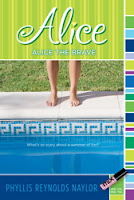
Interestingly, I had not ever actually read Alice the Brave,
only listened to it. And although it was such a formative book for me, I'd never actually re-read it after that first time. So getting ready to read it again, I had to take a deep breath and see if I could re-discover what had made it so impressive for me in the first place. And I did. I'll quote it later. But suffice to say the advice is just as wise today as it was then.
In this book in the series, Alice and her friends are getting ready to start eighth grade. Alice is part of a close group of friends, both boys and girls, and they have spent the summer primarily at one of the group's family pool. Every time they go to the pool, Alice grows increasingly anxious. She is hiding a big secret - she's afraid of swimming in the deep end, and she has been hiding this secret from everyone she knows, including her family. Even worse, the boys in the group have begun sneaking up on the girls and dumping them into the pool. And Alice is sure her turn is next.
Even though this is a fear Alice hasn't previously disclosed to readers before, there are themes that have continued throughout the whole series. One of those themes is growing up. Alice has two best friends - Elizabeth and Pamela. Pamela is always a little ahead of Alice in relationships and life. She knows how the social scene will be in each grade and what they should all do to be popular, including whether or not they should have boyfriends. And Elizabeth is the exact opposite. She is very embarrassed about anything having to do with sex or boys. Elizabeth's mother is pregnant, and Elizabeth cannot even stand to think about how that happened. Alice is squarely in the middle - she has an on-again, off-again boyfriend, Patrick. Even when they are "off" they are best friends and continue to confide in each other and spend time together. But Alice is nowhere near as sophisticated as Pamela either. She tends to follow Pamela's lead (which has gotten her into situations she isn't ready for in other books), even when she isn't sure of what might happen.
During this book Alice and Patrick are back together. Even considering how close they are, Alice has not told Patrick about her fear of the water. He has been gone much of the summer, so it is easy to conceal. But it is almost too much to explain, especially when he asks her to join the swim team with him as a fun school activity that fall. She thinks Patrick won't understand her fear, that he will not want to be seen with her because of her inability to swim. When the whole incident finally comes to a head, Patrick is not there. So Alice has to risk rejection and explain her anxiety to him. Unsurprisingly, Patrick supports Alice and encourages her, telling her they will just have to find something else to do together if they can't join the swim team.
One of the other ongoing themes in these novels is Alice's sense of family. Alice's mother died years ago, before Alice can even remember. But she acutely misses the idea of her mother. Especially as she grapples with growing up, Alice wonders how having a mother in her life would have changed her: "I went up to my room and wondered if it was times like this a mom would come in and sit beside you. Put an arm around you and, no matter how you were feeling, say she'd felt like that once when she was your age." (p. 75) Alice, no matter how she feels about her mother, does have a great amount of support from her father and her brother Lester, who is 21. When Alice confides in Lester that she is afraid to swim in the deep end, Lester comes through for her. He takes her to a friend's pool, where no one else will see them. Lester works with Alice, giving her confidence little by little. It is a sweet moment, and while Lester is a lot older than Alice, he understands her worries, and helps her solve them without giving her all the answers.
Alice, very wisely, eventually realizes that her anxiety about swimming is hurting all of her summer, not just the time she spends at the pool. After all, what seems fairly simple affects everything she does on a daily basis. She observes "If parents knew everything that goes on in their kids' heads, they'd be really surprised, I think. Dad had no idea that I always said 'love you' before I went to Mark's pool so that if that turned out to be the day I sank to the bottom the last thing I would have said to my father was 'love you'" (p. 79). This anxiety and panic really has her in its grip. Again, this is a feeling even adults can relate to, especially the way Alice articulates what she is feeling. She realizes that "There was plenty I could do about mine [my situation], but I was too afraid to try. " (p. 90). She has to, finally, work up the courage to take her fear and face it squarely, and she does.
Alice is, of course, triumphant. But this is not the only worry Alice has in this novel. Alice's father has been dating Alice's sixth grade teacher, Miss Summers. Alice is convinced that her father will ask Miss Summers to marry him. Then it doesn't happen, which leads Alice to start asking questions about the adult relationships around her. She asks her father about why he married her mother, hoping to get an idea about what he is looking for. What he tells her at first - that he might have been happy with someone else besides her mother - scares her. But he goes on to explain "Why did I marry her? Because I knew that she was a woman I could love - that I did love...I had committed to the marriage, Al. That's what makes the difference." (p. 123). This next quote, although long, is what really resonated with me when I read this book the first time. Incredibly, it is just as meaningful to me now. "And suddenly my warm fuzzy feeling was back again, my armor for the first days of eighth grade, and all the other firsts in my life...It was the feeling...if any of the other hundred and one awful possibilities that lurked around the corner were to happen, I would take it....Because I had guts....Alice the Brave, that was me." (p. 123-4). And she IS Alice the Brave. It is a victorious ending for a wonderful, strong character. I love her just as much today. Who could ask for anything more?
Alice the Brave. Phyllis Reynolds Naylor. Aladdin Paperbacks, 1995, 1996.
from my personal collection
I have been reading books for the Cybils like crazy for the last few weeks, and have found some real gems that I can't wait to share with you. Here's the first of the nonfiction picture books that I would like you to track down and read. With the movie out about his life and presidency, Abraham Lincoln is a popular president again. While this book was probably not written to take advantage of the movie's buzz, it will certainly be looked at with interest because of its subject matter. And my hope is that it is read again and again, because of how well it has been created.
The narrator of this book begins by telling the readers that she saw a man while walking in the park. He attracted her attention with his unusual height. He reminded her of someone, but until she finished eating breakfast, she couldn't think who it might be. When they paid, she realized that he looked like the man on the $5 bill - Abraham Lincoln.
Like my own fondest hope for readers, this chance meeting spurs the narrator on to more research. She goes to the library to learn more about Abraham Lincoln's life, but she finds that she can't tear herself away from his face. The narrator recites facts about Lincoln's life and death, inserting her own ponderings, opinions and questions as she goes. By the end of the story, after the narrator (is it Kalman herself, who is an avowed Lincoln aficionado?) has learned about Lincoln's death, the reader has gotten a much fuller appreciation of his humanity as well as Abraham Lincoln's greatness.
There are some things that I find really fascinating about this book. First of all, I love the narrator's emphasis on curiosity and research. She sees the man who reminds her of Lincoln, and that is what sends her directly to the library. She tells readers "Abraham Lincoln was such an amazing man that there are over 16,000 books written about him. I wanted to read them all, but I got lost in photos of his unusual face." The illustration on the facing page shows the narrator, poring over a large portrait of Lincoln. The library is filled with people reading (and one guy sleeping on a book) and learning. It is exactly what librarians hope all readers will do - become enthusiastic about a subject and keep researching and learning.
And while the narrator claims to not be able to read about Lincoln because she is so fixated on his face, the facts she learns and shares form the majority of the book. Another thing that is very unusual about this book is the way Kalman combines facts and fiction in a clear way. She doesn't have to delineate the difference between them - she lets the fonts do it for her. Facts are done in a more typewriterly font, resembling print in a book. Then her opinions or questions about Lincoln are written in a handwriting font. Her questions are fun to read: "I wonder if Mary and Abraham had nicknames for each other." She calls Lincoln's face unusual, calls his wife short and says that his stepmother wasn't as stern as she looks. It brings a light tone to this historical subject and also gives a childlike feel to the book.
Kalman has a very modern illustrative style, and I was very curious about how her style would translate to a historical subject. But it actually works very well. She combines very realistic depictions of the family with other more modern objects or colors. For instance, in a portrait of the Lincoln family, every person looks fairly recognizable, with all of them dressed historically accurately. But some of the children are colored green, which is not as distracting as it sounds. I think her chosen style for this book combines modern with historical, much as Kalman does with the text. It's a well-done book and I recommend it for Lincoln lovers and newcomers alike.
Note: I am on the Cybils Nonfiction Picture Book panel, but this blog post does not represent the committee's thoughts about the book. It only represents my personal ideas and thoughts.
Looking at Lincoln. Maira Kalman. Nancy Paulsen Books: Penguin for Young Readers, 2012.
As you can imagine, I have a pretty large collection of children's literature. I tend to collect books and authors I really love and hold onto them. But three years ago, my family began a pattern of moving once a year, and I had to start giving away books "to better homes". But I held onto the book Our Only May Amelia. But as time went on, the story became more hazy, and I became less sure of its value in my collection. When the sequel, The Trouble with May Amelia, came out last year, I decided to reread the first one as well, in order to decide if it should stay or go. After reading both books together, I am keeping the first one in my collection. I will look at both of these books as an ongoing story and as historical fiction.

Our Only May Amelia was published in 1999, and won a Newbery Honor for that year. The action takes place in 1899, on the Nasel River, in the state of Washington. It is written from May Amelia Jackson's perspective, and she is a spark plug. She introduces her brother Wilbert on the very first page, giving an indication of her personality as much as his. He is her "favorite brother which is something indeed since I have so many brothers, more than any girl should have." (p.1). She has seven brothers. May Amelia is the youngest, but has never been looked at as the baby of the family. She is twelve years old, but does just as much farm work as her older brothers. But she is also always in trouble - she doesn't always think before she acts, she is curious and wants to explore. Her father declares "We're living in wilderness, May Amelia , and you girl have got a Nose for Trouble.". (p. 134). May Amelia talks back when she believes she is right, and like the rest of the Jackson family, she is stubborn.
Life in 1899 rural Washington state isn't easy. You have to be tough and creative to survive. Each member of the family is cognizant of the need to survive financially. The boys, all in their teens, find work when and where they can, including at the logging camp upriver. But they are also part of a immigrant Finn community, and they are highly involved with also helping the entire community survive. May Amelia's mother is heavily, uncomfortably pregnant, but besides caring for her own family, she delivers all the community's
babies. When an aunt cannot afford to take her son with the rest of her family as they move looking for work, Kaarlo is adopted into the Jackson family. He is counted as one of the brothers.
While their life has moments of fun and hilarity, their strength is really shown through their enduring struggle to survive. It can be unrelenting, but this family shoulders their burden and continues forward. They value education and send the younger children to school, but if they are needed at home, there is no protest. And Holm shows all of life on the Nasel River, the good and the truly terrible. One of the most excruciating episodes has to do with Grandmother Patience. Grandmother Patience has moved in with the Jackson family, and she is cruel, crotchety and outspoken. She does not approve of May Amelia and the way she has been raised. One terrifying episode happens with Grandmother Patience sends May Amelia back repeatedly for the correct cup of tea.
"She [Grandmother Patience] bangs the floor with her cane. But I've had all I can take.
There isn't any more honey you Greedy Old Witch! I shout.
She stands up to her full height and shakes her cane at me. She is big, bigger than I thought and she is full of fury. Her mouth is twisted in an evil snarl.
How dare you defy me, you little brat, she says. Go and make me a Cup of Tea." (p. 104)
This woman is truly a villain. Yet May Amelia finds ways to stay true to herself. There is an awful consequence to the incident I quoted above, but that isn't the worst of Grandmother Patience's behavior. And it isn't the worst of what May Amelia will face in this book. But like the rest of her family, May Amelia knows that life must go on and move forward. And she does as well.
There is an author's note at the end of this novel describing where Holm got the idea for this novel. It came from the journal of her grandaunt, Alice Amelia Holm. Jennifer Holm did a lot of research to supplement family stories, and it is written so beautifully that the research doesn't show. The chapters are illustrated with photographs (some of which are from the author's own collection). The sepia tones of the pages and the historical photographs add to the authenticity of this novel.

The Trouble with May Amelia was published in 2011, and it is billed as the sequel to Our Only May Amelia. However, when I got around to reading it, I read it first, without rereading Our Only May Amelia and it does stand very well on its own. The action in this novel takes place about six months after the last novel has concluded. While Holm spends some time re-introducing the Jackson family and their life on the Nasel River, it doesn't feel awkward or forced. Grandmother Patience, who caused so much strife in the first novel, has died, and in one last stroke of cruelty has left her money to one of May Amelia's uncles, even though her family cared for Grandmother Patience selflessly. Money is still an issue, and in this book it is a real focus. Holm also writes about the issues surrounding immigration in this era. A man comes to meet with May Amelia's father, to talk with him about investing in making Nasel a real town with more business, a developed port and increased financial gain for those people willing to become stakeholders. Her father only speaks Finn, and asks May Amelia to do all the translating for him, both verbally and translating the documents he must sign. May Amelia sees this as a pivotal moment in their relationship - that her father finally sees her as truly ready to contribute to her family. So after May Amelia translates everything, her father decides to take a risk and mortgage the family farm to invest. Others in the community who also do not speak English fluently base their decisions to invest on the Jacksons' risk. This is a close-knit community. It is fairly isolated, and even the children who go to school will not speak English. They rely on each other and go out of the community very infrequently. And family members continue to immigrate from Finland, making this group even more prone to rely on each other.
Unfortunately the insularity of this community comes back to haunt them in the end. It ends up that the man who has convinced the town to invest is a con man. Families up and down the river blame their unimaginable loss on the Jackson family's decision. And in an unforgivable turn of events, May Amelia's father blames the con on her. He believes she should have understood better, should have translated more clearly. The family is powerless in the face of his anger and helpless when confronted with his stubborn refusal to see reality. He is stunningly cruel to his only daughter.
Much like the events of the first novel, these events show quite a bit about this family's resiliency, their spirit and strength. This novel is based on events from Holm's great-grandfather's life, and sadly, these events are true. Holm writes about this with compassion and a historian's eye for details of the family's despair. And yet from the truly terrible springs hope and innovation. This family creates a new venture that will bring prosperity.
I did say earlier that these novels could be read alone. The events of the second book are affected by the events of the first, but Holm gives the broad strokes of the Jackson family history in a very natural way in the second book. But when you read these books together, you begin to see a more complete story. In Our Only May Amelia, Holm focuses primarily on family events. She does introduce some neighbors and community members, the book examines each of the family members closely. Readers get to know each one of them - their personalities, their stubbornness, and how May Amelia feels about each one of them. In the second book, Holm is looking at this family within their community. As I mentioned, she looks at the immigrant community and how they operate as a unit. Readers still spend time within the family, but they get to know more of the neighbors, the hope a potential new town brings to Nasel, and the devastation left when this hope disappears.
One of the things I believe works best about this pair of novels is the way Holm crafts her historical fiction. She creates May Amelia as a lively character, one who is easily relatable to readers and is full of spunk. She is very much a girl of 1899, but she bucks against tradition and expectations. There is a family secret that May Amelia isn't privy to at first, although she can sense something isn't being said. When her brothers finally come out with the secret, the explanation is "You're a girl, May, he says. We didn't want to scare you.
Nothing scares me, I say. " (Trouble, p. 75) In her overalls, she is constantly being called a boy and indignantly correcting people: "I ain't no boy!" (Trouble, p. 49). Yet Holm also fills these novels full of the information that gives readers a feeling of the time period. Some of the events take place in and around a logging camp, a dangerous place for all of them. But the money is good, and all of May Amelia's brothers long to work in the camp. There are also scenes in the fish cannery in nearby Astoria that highlight both the terrible status of immigrants and the workforce in such grueling, low-paying jobs.
I could go on and talk about work in these novels, or education, but you get the idea. These novels are rich in family and period detail, but their episodic nature and May Amelia's strong, sympathetic character will keep readers enthralled. One of the other things that I noticed throughout both books was Holm's beautiful, original way of describing things. She describes objects using easily digested language that brings pictures to the reader's mind. From Our Only May Amelia, she writes "the Nasel is as calm and smooth as the inside of a clam's shell." (p. 24). And in The Trouble with May Amelia, Holm describes May Amelia's mother's interaction with a younger cousin: "Mamma spends hours braiding and brushing Helmi's hair until it gleams like fresh milk." (p. 81). She brings these ideas to life by using pictures that transcend the historical time period, making them appropriate both to May Amelia and the reader.
These books are compelling, whether read together or separately. I recommend you find them and acquaint yourself with May Amelia. She's a keeper.
Our Only May Amelia. Jennifer L. Holm. HarperCollins, 1999.
The Trouble with May Amelia. Jennifer L. Holm, illustrated by Adam Gustavson, Atheneum Books for Young Readers, 2011.
both borrowed from Lewis and Clark Library
In 2011, I wrote a post on two books in the Scientists in the Field series. I am a huge advocate for this series - I have raved about it to multiple people and at conferences ever since I first discovered it. But I haven't written about other books in the series, even though I have continued to explore the series ever since. I haven't written about them because I haven't found ones that were different from the series formula I had already discussed. That doesn't mean this is a bad formula. On the contrary, this is an well-constructed, well-thought-out formula. All I can wish is that every middle school science classroom had the complete set on their shelves to inspire young scientists. They show fascinating careers and scientists of all ages and cultures who are passionate about what they do. Most importantly, they talk about the world around us in interesting ways without trivializing the science involved. The scientists profiled and the authors who create the books take the science seriously and take the time and effort to create something readable but also informative. However, I've read two contributions to the series lately that I believe should be recommended, and I want to talk about those here.

The Elephant Scientist won a Nonfiction Honor from the Horn Book magazine this year, and it is well deserved. One of the interesting things about this book is that the scientist herself is one of the authors of the book. Caitlin O'Connell has also taken many of the photographs of her research and field station that are featured in this book. O'Connell has been studying elephant communication in Namibia, in Southern Africa. She has been observing elephant behavior with a research team in hopes of deciphering the elephants' calls as well as how they are able to detect noises through vibrations in the ground. Some of what she is researching has a very practical aspect - farmers in Namibia are frustrated because there is no way to keep elephants out of their farms, where they destroy crops both by eating them and trampling them. O'Connell believes that elephants' calls may hold the key to protecting the farmers' crops in a non-threatening, inexpensive way. She has been studying elephants and their behavior for quite some time, and she and Donna M. Jackson (the co-author for this title) find ways to include this incredible knowledge about elephants along with her research and methodology. Her group creates an incredible field station, and Jackson and O'Connell describe how this field station must function in order to produce credible research, but at the same time, it must not attract negative attention from the animals they are researching. O'Connell and Jackson also discuss elephant behaviors in this book. One of the sections discusses male elephants (bulls) and their social structure. While we tend to think of bulls as aggressive, they also have affiliative (bonding) behaviors and comfort behavior. The older bull elephants help raise and guide the younger elephants, just as in the female herds. O'Connell's love and fascination for these animals shines through on every page. It gives this volume an almost unparalleled intimacy.

In the other volume of this series that I have been thinking about lately, Sneed B. Collard III goes to a reconstructed prairie in Iowa. I just met Collard at the Montana State Reading Conference a couple of weeks ago. At that time, I had this book to re-read and review on the blog, and it was hard not to mention it to him. The grassland that was created in Iowa was the dream of Congressman Neal Smith, who believed that children should be able to see a prairie in their own state, something Iowa had very little of at that time (in the 1980's). They created the prairie meticulously. It was a true community effort - there are photographs here of local people helping to sow native grasses and dancing those seeds into the ground. One of the most unique things about this book is its community - Collard doesn't just profile one scientist in this volume - instead, he emphasizes how many people maintain responsibility for this delicate ecosystem. There is Pauline Drobney, the National Wildlife Refuge's biologist who carefully monitors the plants and native grasses of the prairie. There is Dr. Diane Debinski, who searches for one specific butterfly (the Regal Fritillary) on the prairie. There are the managers who keep the prairie's bison herds healthy, the volunteers who collect and provide seed... this is an ecosystem, and Collard looks at all its working parts in a very compelling way. This story is one man's dream, but it is the community responsibility, and it brings science to life in a different way than some of the other books in the series.
One of the things that I love most about this series (and if you know me, this is no surprise) is its backmatter. I believe strongly that students must be able to read a nonfiction title and springboard to additional resources on that subject or related subjects. I love the bibliographies in these books. They respect the reader - giving the reader plenty of opportunities to move past this particular volume. And both books offer readers a diversity of materials - adult books, books written for young readers, web sites and Internet resources, and in The Elephant Scientist, DVD's too. There are glossaries, indexes and maps to help readers visualize the subject they are learning about.
One of the other things I like most about this series is its design. The creators of the series are very cognizant of making these books interesting to look at. The authors and editors present information in multiple ways to readers. There are sidebars, text boxes and extensive photo captions to pique readers' interest along with the ongoing narrative. All books in the series are true, contemporary research projects, and as such, are illustrated primarily with rich, vivid photographs. This choice also brings readers directly into the scientific environment. These are high-quality books about terrific subjects. I cannot recommend these books highly enough.
The Elephant Scientist. Caitlin O'Connell and Donna M. Jackson; photographs by Caitlin O'Connell and Timothy Rodwell. Houghton Mifflin, 2011.
The Prairie Builders: Reconstructing America's Lost Grasslands. Written and photographed by Sneed B. Collard III, Houghton Mifflin, 2005.
The Elephant Scientist was loaned to me by a friend; The Prairie Builders was borrowed from the Lewis & Clark Library


